“The Southwest is the greatest undiscovered wine region of France...a cluster of often remote appellations, many so small that it’s hard for them to make a wave in the market. They export a bit here, they export a bit there, they sell to the locals – and then all the wine is gone, before the world at large has had a chance to wake up and take notice”
A Cluster of Contrasts
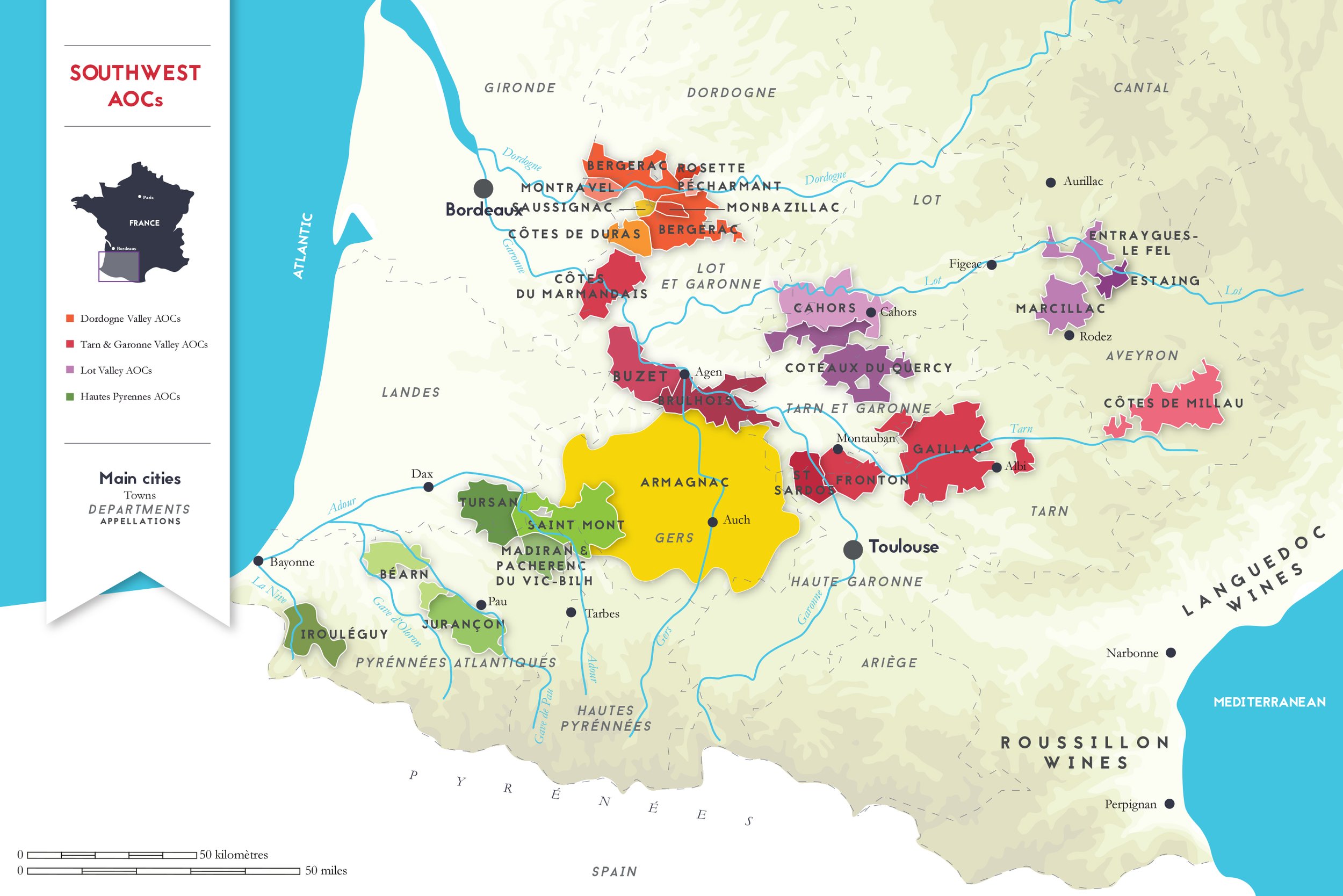
Take it in: the greatest undiscovered wine region of France. 42 appellations in the orbit of Toulouse, scattered like confetti between Bergerac and the Basque Country, the Massif Central and the Pyrenees, and two huge administrative regions: Nouvelle Aquitaine in the west and Occitanie to the east, in the former Midi-Pyrenees.
This vast wine region includes all the vine-growing areas in the southwesterly corner of France except Bordeaux (2) which has its own status. It’s a cluster of contrasts, a constellation of terroirs without a recognizable shape to simplify the storytelling - although, if you look closely, can you see a mythical, supernatural, birdlike creature? Wings spread wide, head held high, breathing in the ocean? “It’s a phoenix” says a vigneron in Gaillac, a member of the collective behind the region’s biggest natural wine fair.
There’s energy in the Southwest - a gravitational force that’s pulling like-minded producers together. They are rising above divisions and distances to unite at Contrastes - a fine and natural Southwest wine fair that will take place for the 3rd time on 9-10 November 2025 in Toulouse : a rare chance for wine professionals to discover high quality wines from 90 growers across the region who all share the same ethos.
A Wealth of Indigenous Grape Varieties
“The Southwest is almost definitionally the Great Other of French wines - a crucible where the lives of grapes come crashing together in tangled and wonderful ways. ”
The Southwest wine region has always been defined by its diversity, which is dazzling, but can also be bewildering. How do you get your head around so many different terroirs, grape varieties and wine styles? I count on the links to bring it into focus, the philosophy shared by the growers combined with the forces of cohesion at play since the beginning of time: two mountain ranges, two river systems, one of the oldest vine-growing regions in France, still home to wild vines, and vineyards located on all the long and winding roads to Saint-Jacques-de-Compostelle.
From 1189, thousands of pilgrims passed through these hills and valleys with cuttings and seeds in their satchels. They gave rise to the abbeys on all the paths to Spain and back, and with them, a multitude of vineyards and grape varieties - the very same you’ll find in a Southwest wine-tasting experience today.
Loin de L’oeil, Mauzac, Bouysselet, Colombard, Petit Manseng to name but a handful of white grapes…Fer Servadou from the Aveyron, known as Braucol in the Tarn and Mansois in Marcillac or Malbec from Cahors, its papa Prunelard in Gaillac or it’s off-spring Jurançon Noir for the reds - or how about Tannat from Madiran, now a star in Uruguay, or Duras, related to Cabernet Franc, parent to Carmenère, Merlot and Cabernet Sauvignon…what will it be for you?
Out of 300 different grape varieties in the Southwest, 130 are indigenous and around 40 feature in contemporary wines. These rare and ancient grape varieties are key to preserve local biodiversity and original flavours, and prioritised by all growers protective of their terroirs. They are a living heritage, the signature of Southwest wine culture, which is rooted in resistance and resilience.
The Dynamics of Terroir
Have you ever met a vigneron who doesn’t love their terroir? Their soils, their vines, their position between earth and sky, and all the micro and macro interactions that take place over a year - the concept of terroir involves involves much more than a production site, it’s a source of creativity for the growers who give it expression, it’s a platform for their sensibility: “terroir is in effect the radio signal, and the winegrower is turning the dial, tuning the radio into that signal” says Jamie Goode[4].
The concept of terroir is also a powerful communication tool - hence the birth of the AOCs (Appellation d’Origine Controlé). Whole wine regions are recognisable thanks to their bedrock, aspect, micro-climate, history etc. - but the vast patchwork of terroirs that make up the Southwest is difficult to assimilate in one sitting. It’s a land of modest farmsteads rather than Grand Châteaux - a wine world within itself between mountains and plains, the Mediterranean sea and the ocean. It’s best wines are discovered through word of mouth, behind closed doors, directly on site by wine lovers less focused on the fame of a terroir and more on the choices of the winemaker - or of course, at “Contrastes”! - the salon that is defining a new movement.
As Pascaline Lepeltier notes in the Terroir chapter of ‘A Thousand Vines’, wine is above all a creative dynamic, not static.
“Isn’t it just as important, especially for the future of wine-growing in the face of climatic and organic changes, to emphasise human freedom, will and power?… Quality wine is above all a creative dynamic, not static ”
The Commitment of the Growers
All this brings me back to the wines you’ll find in my local cellar - wines made by committed growers, always moving, year after year, in rhythm with the seasons, yet never producing quite the same song, always watching, always listening, adapting to myriad vagaries to offer us a taste of living energy.
Wine is like music, when it’s good, you feel it with your body. It takes you somewhere where the clock stops. Like stars in a constellation, it gives you a giddy glimpse of an alternative truth. That’s what happens in my little cave, through a sagrada familia of wine grapes and growers “who are mad to live…who never yawn or say a commonplace thing but burn burn burn like fabulous yellow roman candles, exploding like spiders across the stars” [7]
Isn’t it time to wake up and notice?
[1] Andrew Jefford, Decanter2021, Wine Scholar Guild, 2024
[2] Charlie Leary, Jane Anson – Inside Bordeaux, January 2025
[3] Jon Bonné, The New French Wine, 2023
[4] Dr Jamie Goode at The Sourcing Table
[5] Pascaline Lepeltier, One Thousand Vines, ed. 2022 (ref. Roger Dion “History of the Vine and Wine)
[6] Idem - Pascaline Lepeltier, One Thousand Vines, ed. 2022
[7] Jack Kerouac, On the Road, 1957, ed. 2018